 Add to Chrome
 Add to Firefox
 Add to Edge
A Layer Separation Optimization Framework for Cross-Entropy Training in Deep Learning
Apr 25, 2026
This paper investigates the deep learning optimization problem with softmax cross-entropy loss. We propose a layer separation strategy to alleviate the strong nonconvexity encountered during training deep networks. For cross-entropy models with fully connected and convolutional neural networks, we introduce auxiliary variables associated with hidden layer outputs and construct corresponding layer separation models, which decompose the original deeply nested optimization problem into a sequence of more manageable subproblems. We also conduct theoretical analyses, proving that the new layer separation loss provides an upper bound for the original cross-entropy loss. Moreover, we design alternating minimization algorithms and prove that, under appropriate conditions, these algorithms exhibit decreasing properties of the loss function. Numerical experiments validate the effectiveness of the proposed methods and indicate improved optimization behavior, especially for fully connected and convolutional neural networks.

Rethinking Representations for Cross-Domain Infrared Small Target Detection: A Generalizable Perspective from the Frequency Domain
Apr 02, 2026The accurate target-background separation in infrared small target detection (IRSTD) highly depends on the discriminability of extracted representations. However, most existing methods are confined to domain-consistent settings, while overlooking whether such discriminability can generalize to unseen domains. In practice, distribution shifts between training and testing data are inevitable due to variations in observational conditions and environmental factors. Meanwhile, the intrinsic indistinctiveness of infrared small targets aggravates overfitting to domain-specific patterns. Consequently, the detection performance of models trained on source domains can be severely degraded when deployed in unseen domains. To address this challenge, we propose a spatial-spectral collaborative perception network (S$^2$CPNet) for cross-domain IRSTD. Moving beyond conventional spatial learning pipelines, we rethink IRSTD representations from a frequency perspective and reveal inconsistencies in spectral phase as the primary manifestation of domain discrepancies. Based on this insight, we develop a phase rectification module (PRM) to derive generalizable target awareness. Then, we employ an orthogonal attention mechanism (OAM) in skip connections to preserve positional information while refining informative representations. Moreover, the bias toward domain-specific patterns is further mitigated through selective style recomposition (SSR). Extensive experiments have been conducted on three IRSTD datasets, and the proposed method consistently achieves state-of-the-art performance under diverse cross-domain settings.
Neural Operator-Grounded Continuous Tensor Function Representation and Its Applications
Mar 02, 2026Recently, continuous tensor functions have attracted increasing attention, because they can unifiedly represent data both on mesh grids and beyond mesh grids. However, since mode-$n$ product is essentially discrete and linear, the potential of current continuous tensor function representations is still locked. To break this bottleneck, we suggest neural operator-grounded mode-$n$ operators as a continuous and nonlinear alternative of discrete and linear mode-$n$ product. Instead of mapping the discrete core tensor to the discrete target tensor, proposed mode-$n$ operator directly maps the continuous core tensor function to the continuous target tensor function, which provides a genuine continuous representation of real-world data and can ameliorate discretization artifacts. Empowering with continuous and nonlinear mode-$n$ operators, we propose a neural operator-grounded continuous tensor function representation (abbreviated as NO-CTR), which can more faithfully represent complex real-world data compared with classic discrete tensor representations and continuous tensor function representations. Theoretically, we also prove that any continuous tensor function can be approximated by NO-CTR. To examine the capability of NO-CTR, we suggest an NO-CTR-based multi-dimensional data completion model. Extensive experiments across various data on regular mesh grids (multi-spectral images and color videos), on mesh girds with different resolutions (Sentinel-2 images) and beyond mesh grids (point clouds) demonstrate the superiority of NO-CTR.
TVWorld: Foundations for Remote-Control TV Agents
Jan 19, 2026Recent large vision-language models (LVLMs) have demonstrated strong potential for device control. However, existing research has primarily focused on point-and-click (PnC) interaction, while remote-control (RC) interaction commonly encountered in everyday TV usage remains largely underexplored. To fill this gap, we introduce \textbf{TVWorld}, an offline graph-based abstraction of real-world TV navigation that enables reproducible and deployment-free evaluation. On this basis, we derive two complementary benchmarks that comprehensively assess TV-use capabilities: \textbf{TVWorld-N} for topology-aware navigation and \textbf{TVWorld-G} for focus-aware grounding. These benchmarks expose a key limitation of existing agents: insufficient topology awareness for focus-based, long-horizon TV navigation. Motivated by this finding, we propose a \emph{Topology-Aware Training} framework that injects topology awareness into LVLMs. Using this framework, we develop \textbf{TVTheseus}, a foundation model specialized for TV navigation. TVTheseus achieves a success rate of $68.3\%$ on TVWorld-N, surpassing strong closed-source baselines such as Gemini 3 Flash and establishing state-of-the-art (SOTA) performance. Additional analyses further provide valuable insights into the development of effective TV-use agents.
Sparse Tucker Decomposition and Graph Regularization for High-Dimensional Time Series Forecasting
Jan 01, 2026Existing methods of vector autoregressive model for multivariate time series analysis make use of low-rank matrix approximation or Tucker decomposition to reduce the dimension of the over-parameterization issue. In this paper, we propose a sparse Tucker decomposition method with graph regularization for high-dimensional vector autoregressive time series. By stacking the time-series transition matrices into a third-order tensor, the sparse Tucker decomposition is employed to characterize important interactions within the transition third-order tensor and reduce the number of parameters. Moreover, the graph regularization is employed to measure the local consistency of the response, predictor and temporal factor matrices in the vector autoregressive model.The two proposed regularization techniques can be shown to more accurate parameters estimation. A non-asymptotic error bound of the estimator of the proposed method is established, which is lower than those of the existing matrix or tensor based methods. A proximal alternating linearized minimization algorithm is designed to solve the resulting model and its global convergence is established under very mild conditions. Extensive numerical experiments on synthetic data and real-world datasets are carried out to verify the superior performance of the proposed method over existing state-of-the-art methods.
SWIRL: A Staged Workflow for Interleaved Reinforcement Learning in Mobile GUI Control
Aug 27, 2025
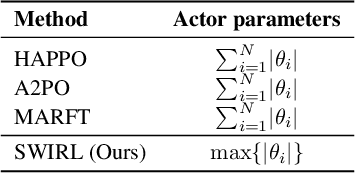
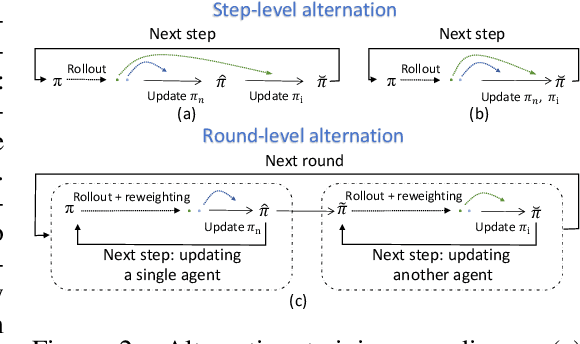
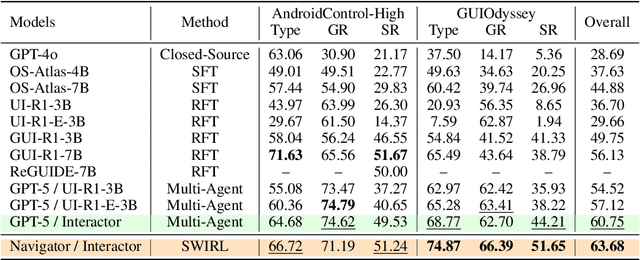
The rapid advancement of large vision language models (LVLMs) and agent systems has heightened interest in mobile GUI agents that can reliably translate natural language into interface operations. Existing single-agent approaches, however, remain limited by structural constraints. Although multi-agent systems naturally decouple different competencies, recent progress in multi-agent reinforcement learning (MARL) has often been hindered by inefficiency and remains incompatible with current LVLM architectures. To address these challenges, we introduce SWIRL, a staged workflow for interleaved reinforcement learning designed for multi-agent systems. SWIRL reformulates MARL into a sequence of single-agent reinforcement learning tasks, updating one agent at a time while keeping the others fixed. This formulation enables stable training and promotes efficient coordination across agents. Theoretically, we provide a stepwise safety bound, a cross-round monotonic improvement theorem, and convergence guarantees on return, ensuring robust and principled optimization. In application to mobile GUI control, SWIRL instantiates a Navigator that converts language and screen context into structured plans, and an Interactor that grounds these plans into executable atomic actions. Extensive experiments demonstrate superior performance on both high-level and low-level GUI benchmarks. Beyond GUI tasks, SWIRL also demonstrates strong capability in multi-agent mathematical reasoning, underscoring its potential as a general framework for developing efficient and robust multi-agent systems.
Deep Learning Optimization Using Self-Adaptive Weighted Auxiliary Variables
Apr 30, 2025In this paper, we develop a new optimization framework for the least squares learning problem via fully connected neural networks or physics-informed neural networks. The gradient descent sometimes behaves inefficiently in deep learning because of the high non-convexity of loss functions and the vanishing gradient issue. Our idea is to introduce auxiliary variables to separate the layers of the deep neural networks and reformulate the loss functions for ease of optimization. We design the self-adaptive weights to preserve the consistency between the reformulated loss and the original mean squared loss, which guarantees that optimizing the new loss helps optimize the original problem. Numerical experiments are presented to verify the consistency and show the effectiveness and robustness of our models over gradient descent.
A Graph-Partitioning Based Continuous Optimization Approach to Semi-supervised Clustering Problems
Mar 06, 2025Semi-supervised clustering is a basic problem in various applications. Most existing methods require knowledge of the ideal cluster number, which is often difficult to obtain in practice. Besides, satisfying the must-link constraints is another major challenge for these methods. In this work, we view the semi-supervised clustering task as a partitioning problem on a graph associated with the given dataset, where the similarity matrix includes a scaling parameter to reflect the must-link constraints. Utilizing a relaxation technique, we formulate the graph partitioning problem into a continuous optimization model that does not require the exact cluster number, but only an overestimate of it. We then propose a block coordinate descent algorithm to efficiently solve this model, and establish its convergence result. Based on the obtained solution, we can construct the clusters that theoretically meet the must-link constraints under mild assumptions. Furthermore, we verify the effectiveness and efficiency of our proposed method through comprehensive numerical experiments.
Low Tensor-Rank Adaptation of Kolmogorov--Arnold Networks
Feb 10, 2025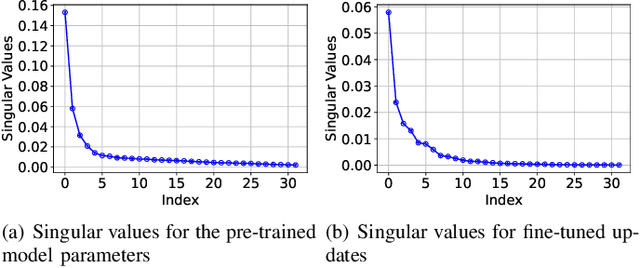
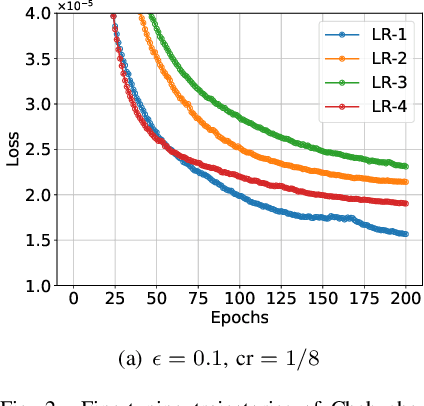
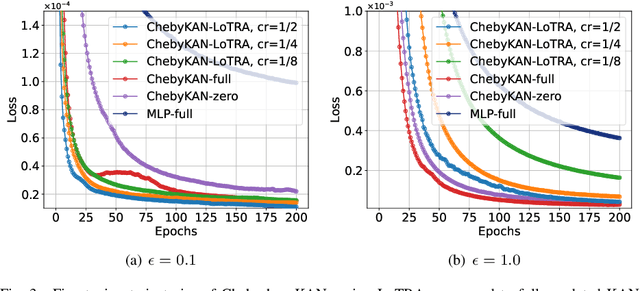
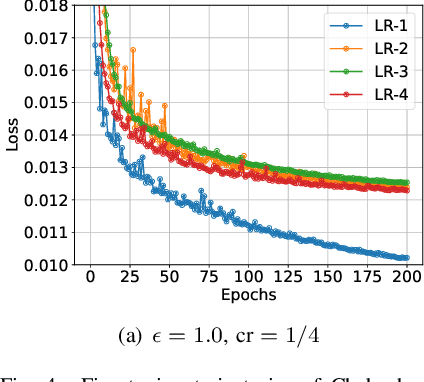
Kolmogorov--Arnold networks (KANs) have demonstrated their potential as an alternative to multi-layer perceptions (MLPs) in various domains, especially for science-related tasks. However, transfer learning of KANs remains a relatively unexplored area. In this paper, inspired by Tucker decomposition of tensors and evidence on the low tensor-rank structure in KAN parameter updates, we develop low tensor-rank adaptation (LoTRA) for fine-tuning KANs. We study the expressiveness of LoTRA based on Tucker decomposition approximations. Furthermore, we provide a theoretical analysis to select the learning rates for each LoTRA component to enable efficient training. Our analysis also shows that using identical learning rates across all components leads to inefficient training, highlighting the need for an adaptive learning rate strategy. Beyond theoretical insights, we explore the application of LoTRA for efficiently solving various partial differential equations (PDEs) by fine-tuning KANs. Additionally, we propose Slim KANs that incorporate the inherent low-tensor-rank properties of KAN parameter tensors to reduce model size while maintaining superior performance. Experimental results validate the efficacy of the proposed learning rate selection strategy and demonstrate the effectiveness of LoTRA for transfer learning of KANs in solving PDEs. Further evaluations on Slim KANs for function representation and image classification tasks highlight the expressiveness of LoTRA and the potential for parameter reduction through low tensor-rank decomposition.
Multisource Collaborative Domain Generalization for Cross-Scene Remote Sensing Image Classification
Dec 05, 2024

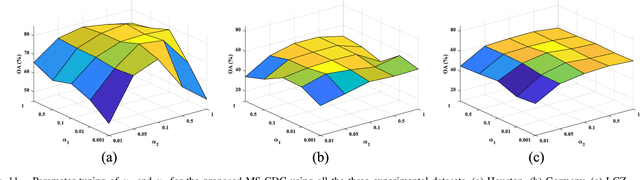
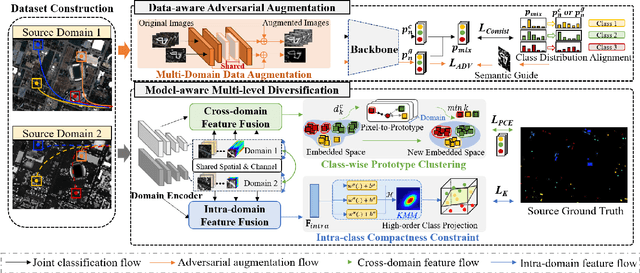
Cross-scene image classification aims to transfer prior knowledge of ground materials to annotate regions with different distributions and reduce hand-crafted cost in the field of remote sensing. However, existing approaches focus on single-source domain generalization to unseen target domains, and are easily confused by large real-world domain shifts due to the limited training information and insufficient diversity modeling capacity. To address this gap, we propose a novel multi-source collaborative domain generalization framework (MS-CDG) based on homogeneity and heterogeneity characteristics of multi-source remote sensing data, which considers data-aware adversarial augmentation and model-aware multi-level diversification simultaneously to enhance cross-scene generalization performance. The data-aware adversarial augmentation adopts an adversary neural network with semantic guide to generate MS samples by adaptively learning realistic channel and distribution changes across domains. In views of cross-domain and intra-domain modeling, the model-aware diversification transforms the shared spatial-channel features of MS data into the class-wise prototype and kernel mixture module, to address domain discrepancies and cluster different classes effectively. Finally, the joint classification of original and augmented MS samples is employed by introducing a distribution consistency alignment to increase model diversity and ensure better domain-invariant representation learning. Extensive experiments on three public MS remote sensing datasets demonstrate the superior performance of the proposed method when benchmarked with the state-of-the-art methods.